第30章:Ports & Adaptersで整理する(置き場所のルール)🔌🗂️
🎯 この章のゴール
- 「ドメインを外の都合(DB/HTTP/外部API)から守る」って何かを説明できる 🛡️✨
- Inbound / Outbound の “Port” を TypeScript の
interfaceで切れる 🧩 - 「どのコードをどこに置くか」のルールを作れて、迷子にならない 🗺️🐾
- ドメインイベントの “配る先” が増えても、ぐちゃぐちゃにならない 🍱➡️✨
🧠 まずイメージ(超ざっくり)🏝️🚢
Ports & Adapters(別名:Hexagonal Architecture)は、
- **中心(ドメイン)**は “業務ルール” だけ 🧠
- 外側(DB/通知/HTTPなど)は “差し替え可能な部品” 🔧
- 真ん中が外側に 依存しない(これが最重要)🔥
この考え方は「UIやDBなしでもアプリが動いてテストできるようにしよう」という狙いで整理されたものだよ 📌 (Alistair Cockburn)
🧩 Ports と Adapters って結局なに?(用語をやさしく)🧸✨
✅ Port(ポート)= “穴(約束)” 🤝🕳️
TypeScript で言うと interface(契約) がいちばん近いよ!
-
Inbound Port(入口の約束):アプリが「提供する機能」の形(= ユースケース)🚪
- 例:
PayOrderUseCase(支払いする)💳
- 例:
-
Outbound Port(出口の約束):アプリが「外にお願いしたいこと」の形(= 外部依存)📤
- 例:
OrderRepository(保存して〜)💾 - 例:
PaymentGateway(決済して〜)🌐
- 例:
ざっくり:
- Inbound = 外 → アプリへ入ってくる
- Outbound = アプリ → 外へ出ていく
「Incoming ports / Outgoing ports」の説明もこの感覚でOKだよ 🧠 (8th Light)
✅ Adapter(アダプター)= “穴に刺さる変換器” 🔌🔁
Port(interface)を 実際に実装する側。
- Inbound Adapter:HTTP/CLI/テストコードなど(入力をアプリの形に変換)🧾➡️🧩
- Outbound Adapter:DB実装、外部API呼び出し、Outbox発行など(アプリのお願いを現実の技術で実現)🧩➡️🛠️
Cockburnの説明でも「外から来たイベントを adapter が手続き呼び出しに変換して渡す / 外へ送る時も port 経由で adapter が技術の信号に変換する」って書かれてるよ 📮🔁 (Alistair Cockburn)
🔥 いちばん大事なルール(依存の向き)➡️🛡️
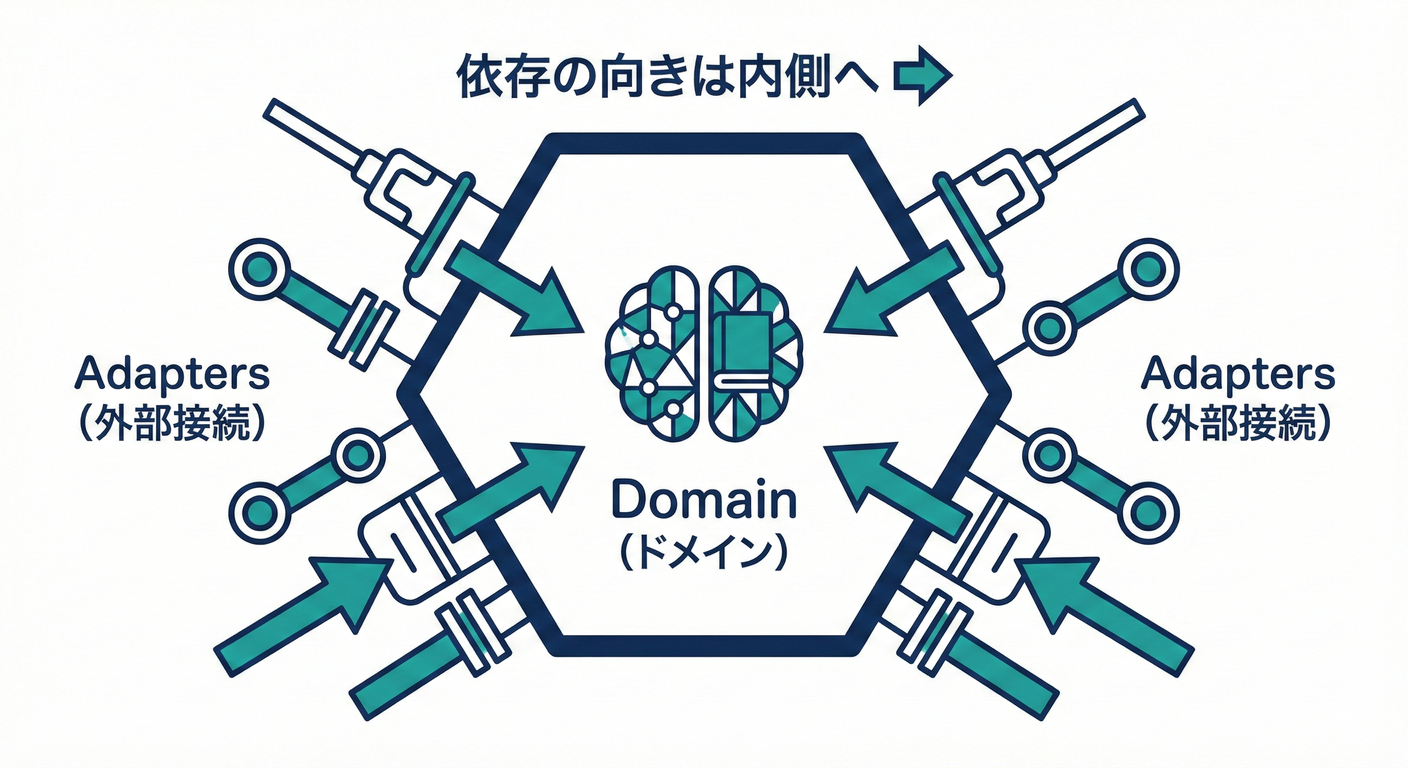
✅ “内側(ドメイン)ほど偉い” 👑
domainは 何にも依存しない(HTTPもDBも知らない)🙅♀️applicationは domain を使う(ユースケースを実行する)🎮infrastructureは port を実装する(現実の技術担当)🛠️
つまり依存はこう👇
infrastructure ---> application ---> domain
逆(domain が infrastructure を import)は 即アウト 🚫😵💫 これが守れると、DBやフレームワークが変わってもドメインが無傷で生き残るよ 🧟♀️✨
🗂️ 置き場所ルール(ミニEC向けフォルダ構成)🛒📦
src/
  domain/
    order/
      Order.ts
    events/
      DomainEvent.ts
  application/
    ports/
      inbound/
        PayOrderUseCase.ts
      outbound/
        OrderRepository.ts
        PaymentGateway.ts
        EventPublisher.ts
    usecases/
      PayOrderService.ts
  infrastructure/
    inbound/
      http/
        payOrderRoute.ts
    outbound/
      memory/
        InMemoryOrderRepository.ts
      payment/
        FakePaymentGateway.ts
      events/
        SimpleEventPublisher.ts
  main.ts
- domain:Entity/VO/不変条件/ドメインイベントを出す場所 🔒🧠
- application:ユースケース(コマンド処理)+ port(interface)📮🧩
- infrastructure:HTTP/DB/外部API/Outboxなど、現実の技術で port を実装 🛠️🌍
- main.ts:全部を組み立てて配線する場所(Composition Root)🧵✨
🛒 ミニECでやってみる(支払いユースケース)💳✨
1) domain:ドメインイベントの型 🧾🧠
// src/domain/events/DomainEvent.ts
export type DomainEvent<TType extends string, TPayload> = Readonly<{
  eventId: string;
  occurredAt: string;      // ISO文字列(例: new Date().toISOString())
  aggregateId: string;
  type: TType;
  payload: TPayload;
}>;
2) domain:Order が状態変更してイベントを “ためる” 🫙✨
// src/domain/order/Order.ts
import { DomainEvent } from "../events/DomainEvent.js";

type OrderStatus = "Created" | "Paid";

type OrderPaid = DomainEvent<
  "OrderPaid",
  { orderId: string; amount: number }
>;

export class Order {
  private status: OrderStatus = "Created";
  private readonly events: DomainEvent<string, unknown>[] = [];

  constructor(
    public readonly id: string,
    private amount: number
  ) {}

  pay(nowIso: string, eventId: string) {
    if (this.status === "Paid") throw new Error("すでに支払い済みだよ💦");

    this.status = "Paid";

    const ev: OrderPaid = {
      eventId,
      occurredAt: nowIso,
      aggregateId: this.id,
      type: "OrderPaid",
      payload: { orderId: this.id, amount: this.amount },
    };

    this.events.push(ev);
  }

  pullDomainEvents() {
    const copied = [...this.events];
    this.events.length = 0;
    return copied;
  }
}
ポイント👇
- Order は DBもメールも知らない 🙅♀️
- ただ「支払われた」という事実をイベントとして出すだけ 💡
3) application:Outbound Port(外にお願いする約束)📤🤝
// src/application/ports/outbound/OrderRepository.ts
import { Order } from "../../../domain/order/Order.js";

export interface OrderRepository {
  findById(id: string): Promise<Order | null>;
  save(order: Order): Promise<void>;
}
// src/application/ports/outbound/PaymentGateway.ts
export interface PaymentGateway {
  charge(orderId: string, amount: number): Promise<void>;
}
// src/application/ports/outbound/EventPublisher.ts
import { DomainEvent } from "../../../domain/events/DomainEvent.js";

export interface EventPublisher {
  publish(events: DomainEvent<string, unknown>[]): Promise<void>;
}
4) application:Inbound Port(ユースケースの入口)🚪✨
// src/application/ports/inbound/PayOrderUseCase.ts
export interface PayOrderUseCase {
  execute(input: { orderId: string }): Promise<void>;
}
5) application:ユースケース本体(Portを使って進める)🎮🧩
// src/application/usecases/PayOrderService.ts
import { PayOrderUseCase } from "../ports/inbound/PayOrderUseCase.js";
import { OrderRepository } from "../ports/outbound/OrderRepository.js";
import { PaymentGateway } from "../ports/outbound/PaymentGateway.js";
import { EventPublisher } from "../ports/outbound/EventPublisher.js";

const newId = () => crypto.randomUUID();

export class PayOrderService implements PayOrderUseCase {
  constructor(
    private readonly orders: OrderRepository,
    private readonly payments: PaymentGateway,
    private readonly events: EventPublisher
  ) {}

  async execute(input: { orderId: string }) {
    const order = await this.orders.findById(input.orderId);
    if (!order) throw new Error("注文が見つからないよ🥲");

    // 外部決済(副作用)は application から port 経由でお願いする
    // ※ ここを Outbox 方式にするのは第20〜23章の話とつながるよ🗃️✨
    await this.payments.charge(order.id, /*amountは本来orderから*/ 1000);

    order.pay(new Date().toISOString(), newId());

    await this.orders.save(order);

    const domainEvents = order.pullDomainEvents();
    await this.events.publish(domainEvents);
  }
}
ここが Ports & Adapters の気持ちよさポイント👇😍
- ユースケースは interface(port)だけ知ってる
- 実体が DB でもメモリでも、決済が本物でもダミーでも、差し替えOK 🔁✨
6) infrastructure:Outbound Adapter(port の実装)🛠️
// src/infrastructure/outbound/memory/InMemoryOrderRepository.ts
import { OrderRepository } from "../../../application/ports/outbound/OrderRepository.js";
import { Order } from "../../../domain/order/Order.js";

export class InMemoryOrderRepository implements OrderRepository {
  private store = new Map<string, Order>();

  async findById(id: string) {
    return this.store.get(id) ?? null;
  }

  async save(order: Order) {
    this.store.set(order.id, order);
  }
}
// src/infrastructure/outbound/payment/FakePaymentGateway.ts
import { PaymentGateway } from "../../../application/ports/outbound/PaymentGateway.js";

export class FakePaymentGateway implements PaymentGateway {
  async charge(orderId: string, amount: number) {
    // 本物は外部APIを呼ぶところ🌐
    console.log("決済したことにするよ💳✨", { orderId, amount });
  }
}
// src/infrastructure/outbound/events/SimpleEventPublisher.ts
import { EventPublisher } from "../../../application/ports/outbound/EventPublisher.js";
import { DomainEvent } from "../../../domain/events/DomainEvent.js";

export class SimpleEventPublisher implements EventPublisher {
  async publish(events: DomainEvent<string, unknown>[]) {
    for (const ev of events) {
      console.log("イベント発行📣", ev.type, ev);
    }
  }
}
7) infrastructure:Inbound Adapter(HTTPっぽい入口)🌐➡️🚪
フレームワークは何でもいいけど、やることは同じ👇 「外の入力」→「ユースケースの形」へ変換して呼ぶだけ!
// src/infrastructure/inbound/http/payOrderRoute.ts
import { PayOrderUseCase } from "../../../application/ports/inbound/PayOrderUseCase.js";

export async function payOrderRoute(
  usecase: PayOrderUseCase,
  req: { params: { orderId: string } }
) {
  await usecase.execute({ orderId: req.params.orderId });
  return { status: 204 };
}
8) main.ts:配線(Composition Root)🧵✨
ここだけが「どの実装を使うか」を知ってればOK!
// src/main.ts
import { PayOrderService } from "./application/usecases/PayOrderService.js";
import { InMemoryOrderRepository } from "./infrastructure/outbound/memory/InMemoryOrderRepository.js";
import { FakePaymentGateway } from "./infrastructure/outbound/payment/FakePaymentGateway.js";
import { SimpleEventPublisher } from "./infrastructure/outbound/events/SimpleEventPublisher.js";
import { payOrderRoute } from "./infrastructure/inbound/http/payOrderRoute.js";

const orders = new InMemoryOrderRepository();
const payments = new FakePaymentGateway();
const publisher = new SimpleEventPublisher();

const payOrder = new PayOrderService(orders, payments, publisher);

// HTTPっぽく呼んでみる
await payOrderRoute(payOrder, { params: { orderId: "order-1" } });
✨ ありがち事故と回避ワザ(初心者がハマりやすい)🧯😵💫
🚫 事故1:domain が DB を import しちゃう
- 症状:
domain/Order.tsにPrismaとか出てくる 😱 - 対策:domain は 純粋にルールだけ。保存は port に丸投げ 💾➡️📤
🚫 事故2:port が “具体技術の言葉” をしゃべり出す
- 悪い例:
saveToDynamoDb()みたいな名前 😵 - 良い例:
save()/findById()みたいに “目的” で言う 🧠✨
🚫 事故3:infrastructure がユースケースをやり始める
- 症状:HTTPのルートで business logic こねこねしだす 🍝
- 対策:infrastructure は 変換だけ(入力↔アプリ)🔁
🧪 テストがラクになるのがご褒美だよ🍬✨
Ports & Adapters だと、ユースケースのテストはこうなる👇
PaymentGatewayをダミーにする 🎭OrderRepositoryをメモリにする 🧠- 外部APIもDBも起動いらない 💨
「テストが速い」=「改善が速い」=「設計が育つ」🌱🧪✨
📝 演習(手を動かすやつ)✍️💖
演習1:フォルダに置いてみよう🗂️
src/domain/src/application/src/infrastructureを作る- 上のファイルをコピペで置く
- import の向きが守れてるかチェック(逆向きがないか)🔍
✅ できたら:infrastructure を消しても domain はコンパイルできる状態が理想だよ ✨
演習2:Outbound Port を1個増やす(通知)📩
NotificationSenderport を作るOrderPaidを受けて「通知したことにする」adapter を作るmain.tsで差し替える
🎯 ゴール:通知方法(メール/LINE/Push)が変わっても domain が無傷 🛡️✨
演習3:Outboxっぽくする(第20〜23章と接続)🗃️
EventPublisher.publish() の中身を「今すぐ送る」じゃなくて
「Outboxに保存する」に差し替える(メモリでもOK)🔁✨
🤖 AI活用プロンプト(そのままコピペOK)🧠💬
あなたはソフト設計レビュー担当です。
このリポジトリは Ports & Adapters を目指しています。

1) domain が infrastructure に依存している import を列挙して、直し方を提案して。
2) port(interface) の命名が「技術寄り」になっているものがあれば、目的寄りの名前に変えて案を出して。
3) inbound adapter が business logic を持ってしまってる箇所があれば、usecase に移す分割案を出して。

(対象コードをこのあと貼ります)
このユースケースの入出力(DTO)を、外部API/DBの都合が漏れない形に整えたいです。
- 入力の最小セット
- 出力の最小セット
- domain に置くべき値オブジェクト候補
を提案してください。
🆕 2026っぽい小ネタ(TypeScript実行まわり)⚡🪄
最近の Node.js は、条件つきで TypeScriptをそのまま実行できるよ(型を“剥がす”方式)👕✨
- Node v22.18.0 以降なら、erasableなTS構文だけならフラグなしで実行OK 🏃♀️💨 (Node.js)
enumやnamespaceみたいな “変換が必要なTS” を使うなら--experimental-transform-typesが必要になることがあるよ 🔧 (Node.js)- Node公式は「エディタ設定や
tscは Node の挙動に合わせて、TypeScript 5.7+ を使うのがおすすめ」って書いてるよ 🧩 (Node.js) - ちなみに Node のページには 最新LTSや最新Releaseの番号も載ってる(今どれ使う?の確認に便利)📌 (Node.js)
✅ この章のまとめ(ここだけ覚えれば勝ち)🏆✨
- Port = interface(約束)、Adapter = 実装(変換器) 🔌
- 依存は infrastructure → application → domain の一方通行 ➡️
- ドメインイベントは domain が生み、application が配り、infrastructure が外へ届ける 📣🚚
- 置き場所ルールができると、機能追加もテストもスイスイ進むよ 🛼💖